By Admin / 26 Aug 2026
How Kinematics, Liquid Dynamics, and Production Speeds Dictate the Right Motion Profile for Your Packaging Line
- Engineering
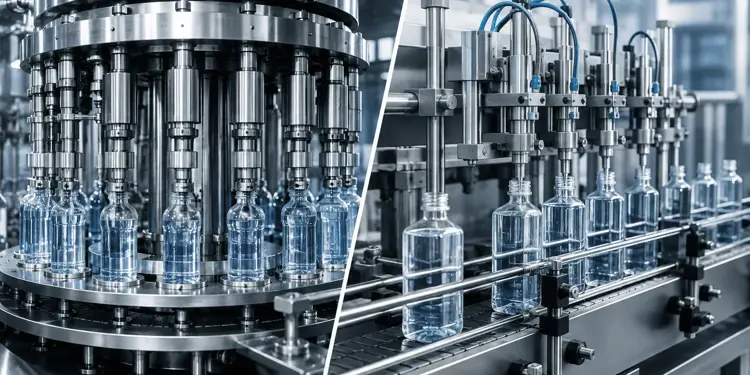
In the world of industrial processing—whether for beverage bottling, edible oils, pharmaceuticals, or personal care products—the filling and capping stage is often the single most critical bottleneck in the entire plant.
When designing or upgrading a packaging line, engineers and factory owners face a fundamental mechanical choice early in the layout phase: Should you install a Linear Filling System or a Rotary Filling System?
Both technologies achieve the same end goal—getting a precise volume of liquid or powder into a container and sealing it—but their mechanical architecture, container kinematics, and operational economics are completely different.
Here is an engineering breakdown of how both systems work, their mechanical mechanics, and how to choose the right system for your production requirements.
In a Linear System, containers travel down a single conveyor belt in a straight line.
[ Conveyor Belt ] ---> [ Infeed Stopper ] ---> [ Filling Nozzles ] ---> [ Outfeed Stopper ] --->
                                                  ||||||||
                                              (Index & Fill Phase)
Indexing: Pneumatic indexing pins or starwheels hold a batch of containers (e.g., 4, 6, 8, or 12 bottles) directly under a stationary rack of nozzles.
Dwell Phase: The conveyor stops (or pauses briefly). The nozzle assembly dives downward into the bottle necks.
Filling: The pump or volumetric piston dispenses the fluid into the stationary bottles.
Release: The nozzles lift, the outfeed pin opens, and the filled bottles move down the conveyor to the next stage while the next batch moves in.
Ease of Changeover: Adjusting for a different bottle width or height is straightforward. You adjust guide rails, change index pin timing, and swap out nozzle racks.
Lower Initial Capital Cost: Fewer moving parts, simpler frames, and standard inline conveyors make linear machines cost-effective to manufacture and purchase.
Modular Upgradability: You can start a plant with a 4-head linear filler frame and later expand it to an 8-head or 12-head system as production demand grows.
Smaller Footprint Widthwise: Perfect for long, narrow factory floor layouts.
Intermittent Motion: Because the bottles must constantly start, stop, fill, and accelerate, the liquid inside can slosh at higher speeds.
Speed Ceiling: Linear systems typically cap out around 40 to 120 bottles per minute (BPM) depending on bottle shape and liquid viscosity. Beyond this, mechanical wear on indexing stoppers and liquid splashing become major issues.
In a Rotary System, containers never stop moving. The filling process happens continuously while the bottles travel in a circle around a central rotating carousel.
                [ Rotary Filling Carousel ]
                      /    \
  [ Infeed Scroll ]  (  ◯◯◯  )  [ Outfeed Starwheel ]
         ↓            \    /           ↓
  [ Infeed Conveyor ] ------------> [ Outfeed Conveyor ]
Infeed & Timing: An infeed timing scroll (worm screw) spaces incoming bottles evenly. An infeed starwheel transfers each bottle into a pocket on the rotating main carousel.
Continuous Filling: Each bottle sits on a platform below a dedicated filling valve attached to the central liquid tank. As the carousel rotates (often 180° to 270° of the circle), the valve opens and fills the moving bottle.
Outfeed Transfer: Once filled, an outfeed starwheel smoothly transfers the bottles back onto a discharge conveyor without interrupting line momentum.
Extreme Throughput: Rotary fillers can comfortably operate at speeds from 120 BPM up to 800+ BPM (such as in high-speed carbonated beverage or water bottling lines).
Smooth Liquid Dynamics: Because bottles travel continuously without sudden start-stop deceleration, there is virtually zero sloshing, allowing for higher fill heights and less product waste.
Precise Mechanical Timing: Everything is mechanically linked via central drive gears, timing belts, or synchronized servo motors, ensuring rock-solid repeatability.
High Mechanical Complexity: Requires custom-machined starwheels, center guides, rotary manifolds, and slip rings for electrical/pneumatic signals.
Higher Capital & Tooling Costs: Every bottle shape requires its own dedicated set of change parts (starwheels, timing screws, platform plates).
Floor Footprint: Rotary carousels require significant diameter clearance on the factory floor.
Regardless of whether a machine is Linear or Rotary, the mechanical pump and nozzle mechanism must match the fluid's physical properties:
Product Viscosity / Behavior | Recommended Pump Mechanics | Nozzle Design Considerations |
|---|---|---|
Thin/Watery (Water, Juices, Alcohol) | Gravity, Overflow, or Peristaltic | Simple shut-off nozzles to prevent dripping. |
Viscous / Heavy (Edible Oils, Syrups, Honey) | Piston Pumps, Rotary Lobe Pumps, or Positive Displacement | Positive shut-off nozzles with blow-back or drip trays. |
Foaming Liquids (Detergents, Soaps, Milk) | Volumetric Mass Flowmeters or Servos | Bottom-up filling (nozzles dive to the bottom and lift as the fluid rises). |
Feature / Metric | Linear Filling Systems | Rotary Filling Systems |
|---|---|---|
Typical Speed Range | 20 – 120 Bottles/Min | 120 – 800+ Bottles/Min |
Motion Profile | Intermittent (Start-Stop) | Continuous (Rotary Kinematics) |
Changeover Time | Fast (15–30 mins) | Moderate to Slow (1–2 hours) |
Custom Tooling Needs | Minimal / Universal Guides | High (Specific Starwheels per bottle) |
Maintenance Complexity | Low to Moderate | Moderate to High |
Best Suited For | Medium plants, multi-SKU lines, frequent bottle changes | High-volume single-product lines (Water, Beverage, Oil mass production) |
When consulting factory owners or designing a production line, the decision isn't simply "which machine is better"—it's which motion profile matches the business model:
Choose Linear if: You produce multiple bottle sizes in short batches, have limited capital budget, need fast changeover between products, and target throughput under 100–120 bottles per minute.
Choose Rotary if: You are running dedicated 24/7 production for high-volume products where maximum speed, smooth bottle handling, and line efficiency are paramount.

By Admin / 26 Aug 2026

By Admin / 24 Aug 2026

By Admin / 21 Jul 2026